Haoming Wang
PhD Student · University of Pittsburgh

US, Pennsylvania, Pittsburgh
Hi! I'm Haoming Wang, a PhD student at the Department of Electrical and Computer Engineering at the University of Pittsburgh, working in the Intelligent System Lab advised by Prof. Wei Gao. I previously earned my bachelor's degree in Automation from the Department of Control Science and Engineering at Zhejiang University, with honors from the Chu Kochen Honors College.
My research centers on multimodal large language models for spatial reasoning and on-device deployment. I am also interested in explainability and resource-aware personalization.
I am on track to graduate in 2027 and am actively seeking research internship opportunities. I welcome any inquiries to connect.
Contact: haw200 AT pitt.edu


news
recent work
-
preprint
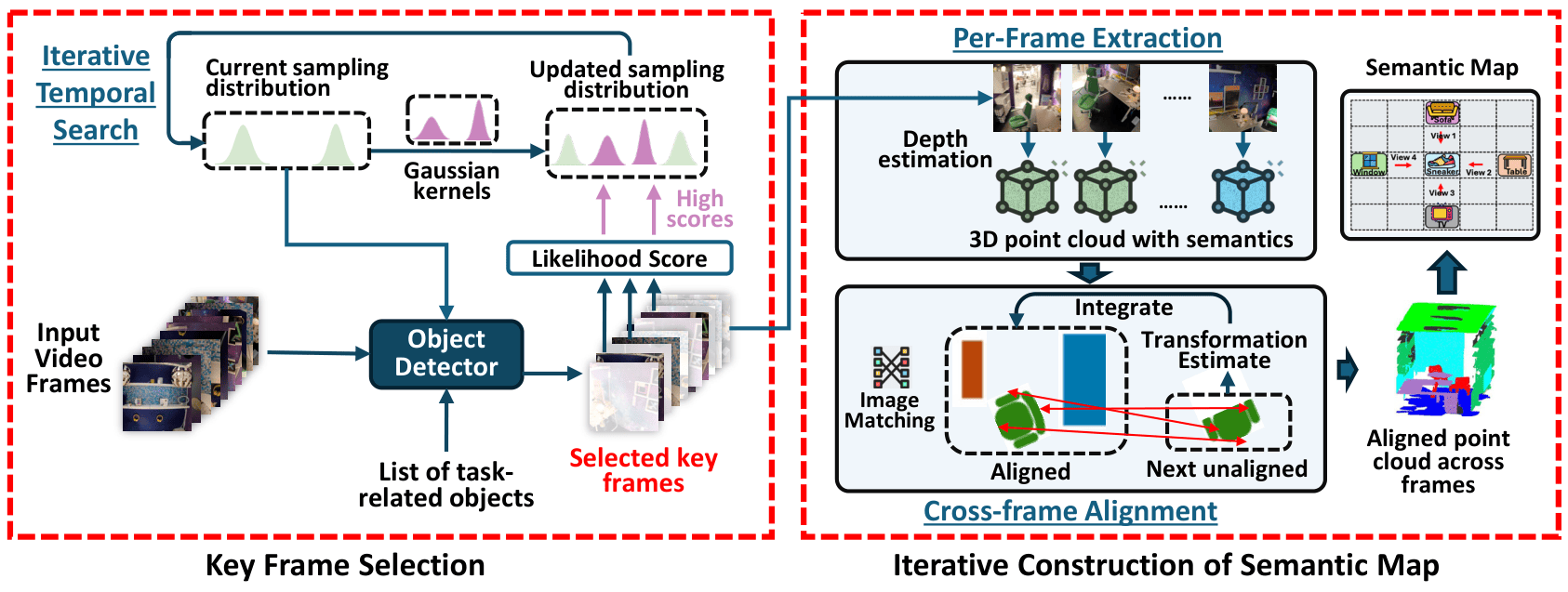 MosaicThinker: On-Device Visual Spatial Reasoning for Embodied AI via Iterative Construction of Space Representation2026
MosaicThinker is an inference-time method for on-device embodied AI that fuses spatial cues from multiple video frames into a unified semantic map, then prompts a small VLM to reason over it. The approach upgrades cross-frame spatial reasoning accuracy on resource-constrained devices across diverse manipulation and planning tasks.
selected publications
-
CVPR oral
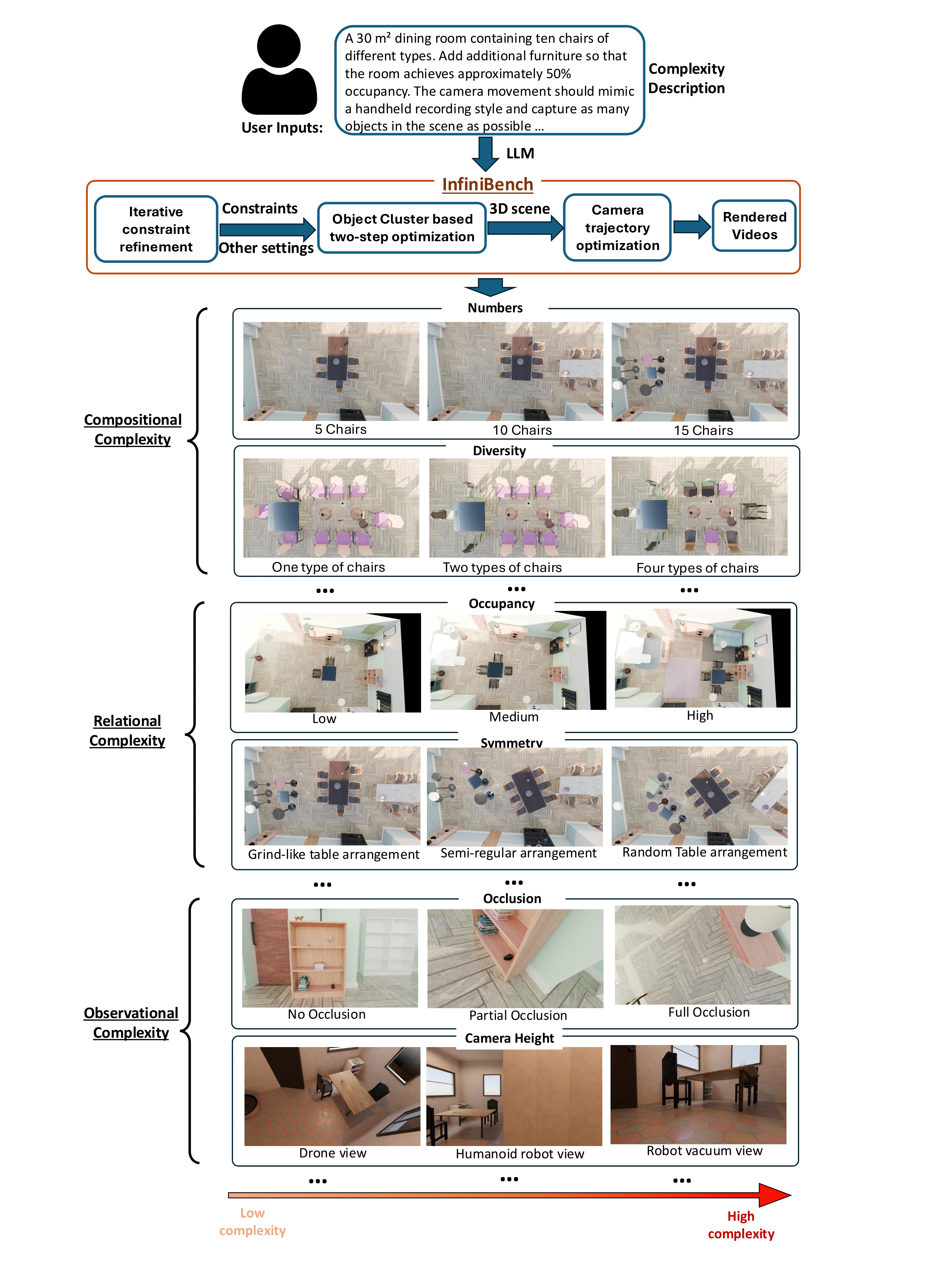 [CVPR26 oral] InfiniBench: Infinite Benchmarking for Visual Spatial Reasoning with Customizable Scene ComplexityProceedings of the IEEE/CVF Conference on Computer Vision and Pattern Recognition 2026 (accepted), 2026
Modern VLMs require robust spatial-reasoning evaluation, but existing benchmarks lack diversity, scalability, and fine-grained control over scene complexity. To address this, we introduce InfiniBench, a fully automated and customizable benchmark generator capable of producing an unlimited variety of photo-realistic 3D scenes and videos from natural-language descriptions. Through its agentic constraint-refinement framework, cluster-based layout optimizer, and task-aware camera trajectory design, InfiniBench enables precise analysis of VLM failure modes and outperforms prior 3D generation methods, while supporting diverse spatial-reasoning tasks such as measurement, perspective-taking, and spatiotemporal tracking.
-
MobiSys
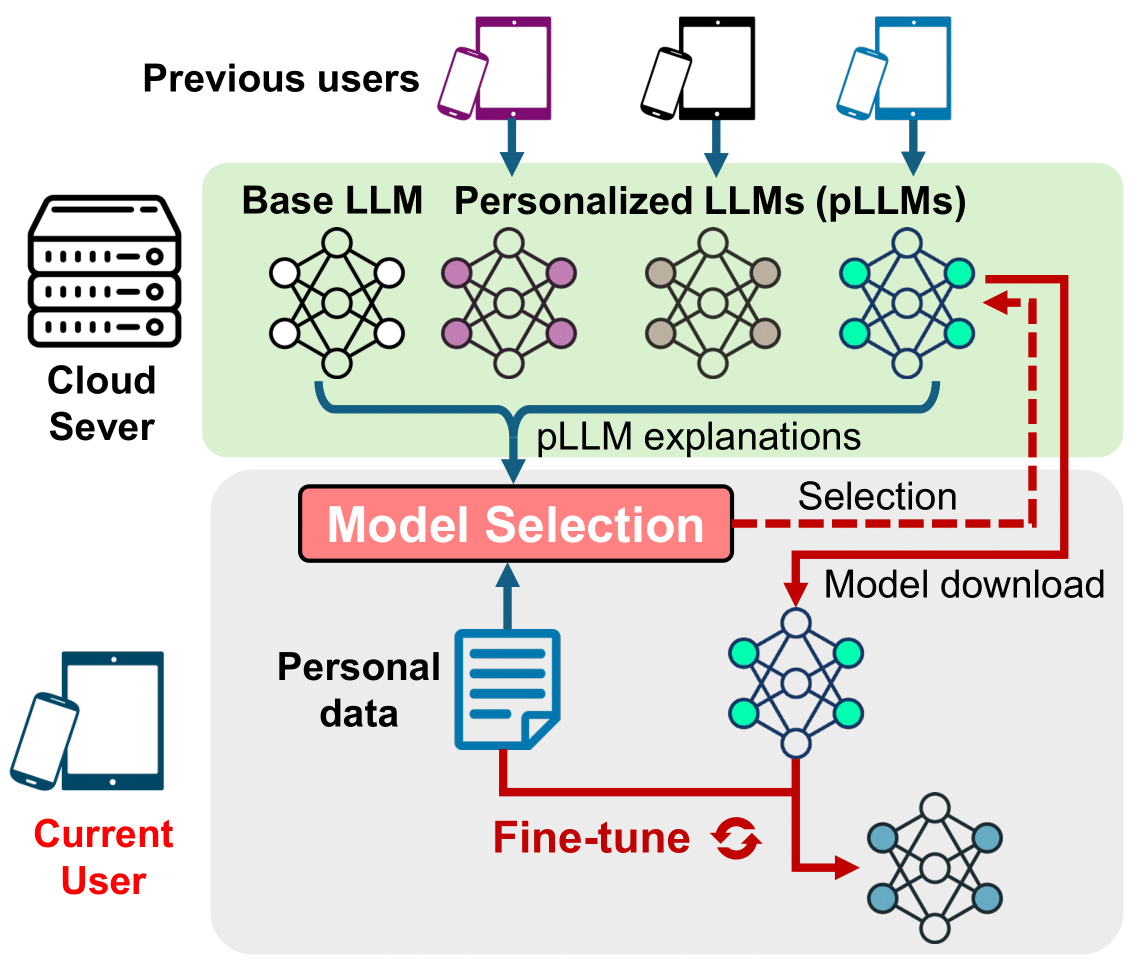 [MobiSys25] Never Start from Scratch: Expediting On-Device LLM Personalization via Explainable Model SelectionProceedings of the 23rd Annual International Conference on Mobile Systems, Applications and Services (Acceptance Ratio: 18.0%), 2025
Personalizing Large Language Models (LLMs) is crucial for meeting individual user needs on mobile devices. However, on-device personalization faces challenges from limited computational resources and scarce personal data. We propose XPerT, a technique that fine-tunes an already personalized LLM using user data and selects models based on explainability of prior fine-tuning.
-
MobiCom
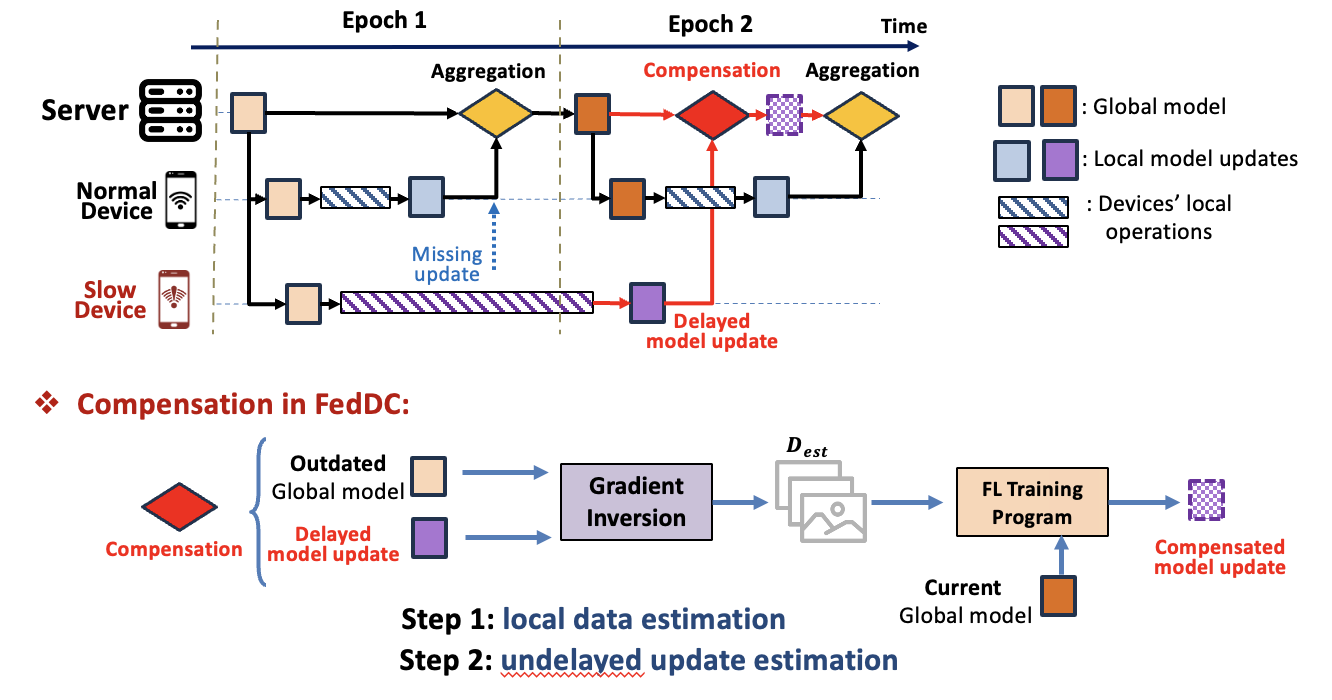 [MobiCom25] When Device Delays Meet Data Heterogeneity in Federated AIoT ApplicationsProceedings of the 31st ACM International Conference on Mobile Computing and Networking (Acceptance Ratio: 17.1%), 2025
Federated AIoT leverages distributed IoT data to train AI models, but heterogeneous devices introduce data heterogeneity and varying staleness, degrading model performance and slowing training. Existing FL frameworks treat device delays as independent of data heterogeneity, which is unrealistic. We propose FedDC, a technique that mitigates delay impacts when these factors are correlated. FedDC uses gradient inversion to infer local data distributions and compensate for delay-induced update bias.
-
AAAI
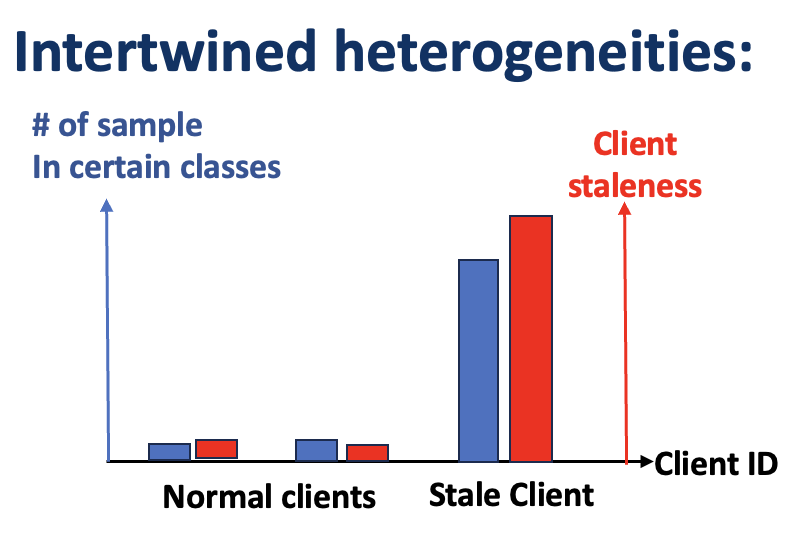 [AAAI25] Tackling Intertwined Data and Device Heterogeneities in Federated Learning with Unlimited StalenessProceedings of the 39th Annual Conference on Artificial Intelligence (Acceptance Ratio: 23.4%), 2025
Federated Learning (FL) is challenged by intertwined data and device heterogeneities—differences in clients’ local data distributions and model update staleness. Traditional FL methods treat these separately, which is unrealistic and often ineffective. We propose a novel FL framework that converts stale model updates into unstale ones, addressing these intertwined heterogeneities efficiently. Our method estimates clients’ local data distributions from their stale updates to compute unstale updates, without requiring auxiliary datasets, fully trained local models, or extra client-side computation or communication.
preprints
-
preprint
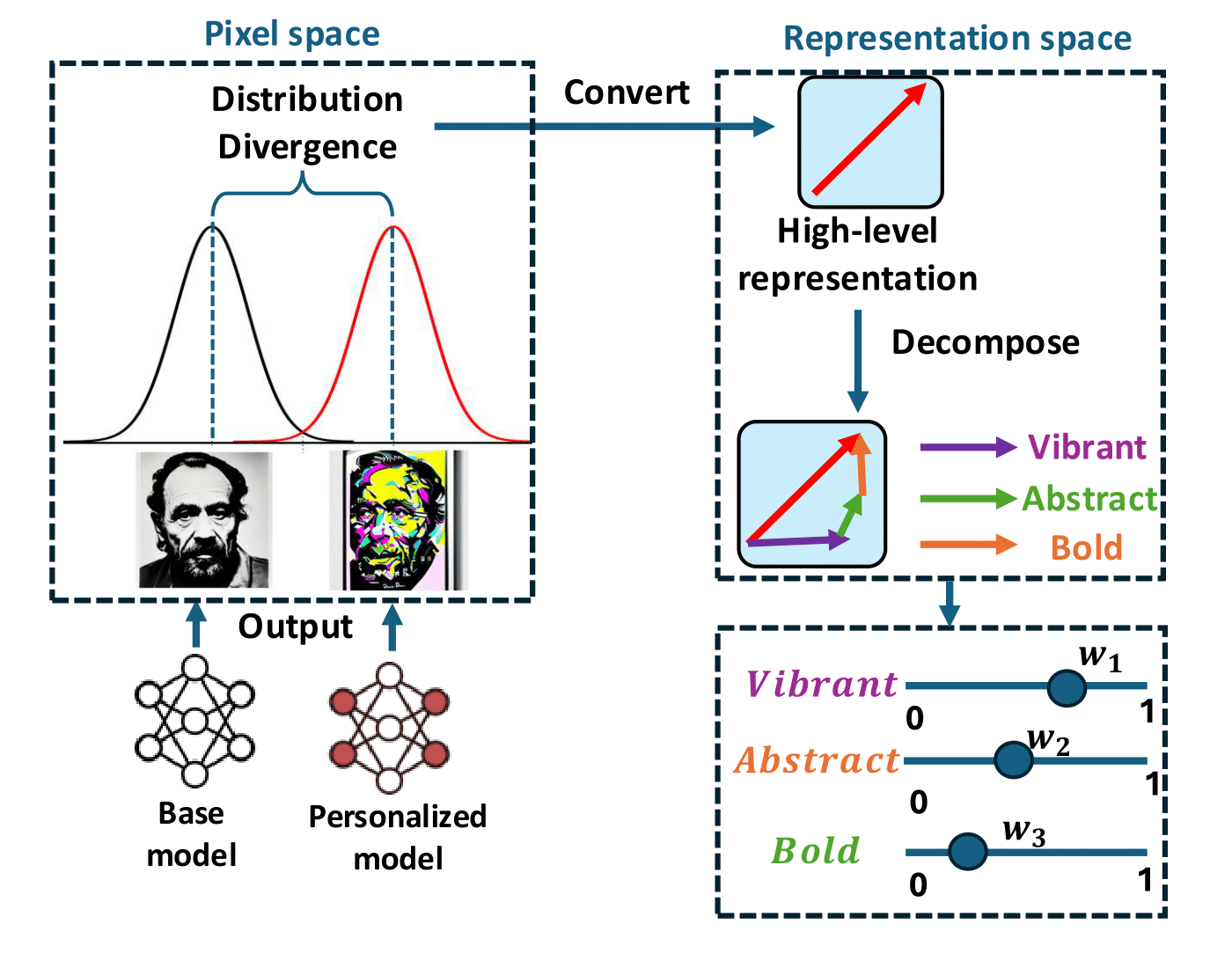 Deciphering Personalization: Towards Fine-Grained Explainability in Natural Language for Personalized Image Generation Modelspreprint, 2025
Personalized image generation models better serve diverse user needs but often lack explainability regarding how personalization occurs. While visual cues exist, they are hard for users to interpret, and current natural language explanations are too coarse-grained to capture multiple aspects or degrees of personalization. We propose FineXL, a technique for Fine-grained eXplainability in natural Language, which generates detailed textual descriptions and quantitative scores for each personalization aspect.
-
preprint
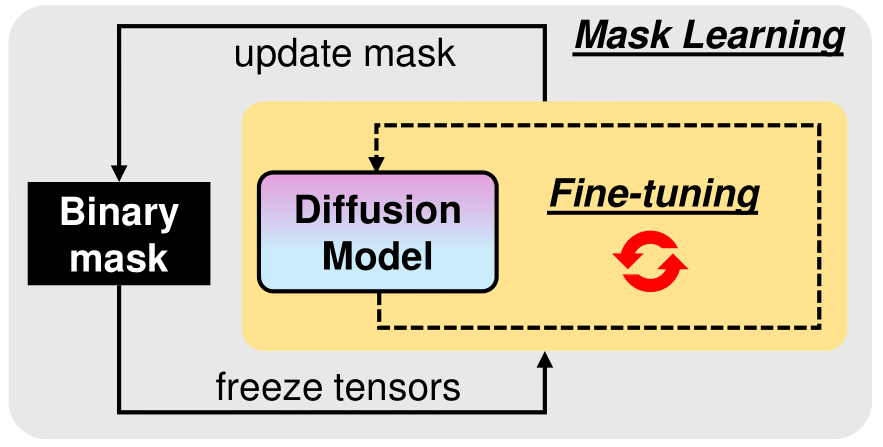 Freezeasguard: Mitigating illegal adaptation of diffusion models via selective tensor freezingpreprint, 2024
Text-to-image diffusion models can be fine-tuned for personalized domains, but this adaptability also enables misuse, such as forging public figures, replicating copyrighted artworks, or producing explicit content. Existing detection or unlearning methods fail to prevent illegal adaptations. We introduce FreezeAsGuard, a technique that irreversibly mitigates such misuse by selectively freezing tensors in pre-trained diffusion models that are critical to illegal adaptations, while preserving legal fine-tuning capabilities.
other
-
under reviewGlobalNav: Daily Object Navigation in VLM-based Autonomous Mobile Systems with Aligned Local and Global Viewsunder review, 2026
-
under reviewHEVEN: Small Object Search and Navigation on VLM-Based Autonomous Mobile Systemsunder review, 2026
-
noteSpatial Reasoning in Multimodal Large Language Models: A Survey of Tasks, Benchmarks and Methodstechnical report, 2024
experience
- ECE 1175 — Embedded System Design (Fall 2024)
- ECE 1195 — Advanced Digital Design (Spring 2025)
- ECE 1396 — Introduction to Machine Learning (Fall 2025)
- ECE 2570 — Robotic Control (Spring 2026)